LED 101 / Basics
Contrast ratio
Contrast is the gap between the brightest white and the darkest black the wall can show. On LED, the mask and the room lighting matter as much as the datasheet.
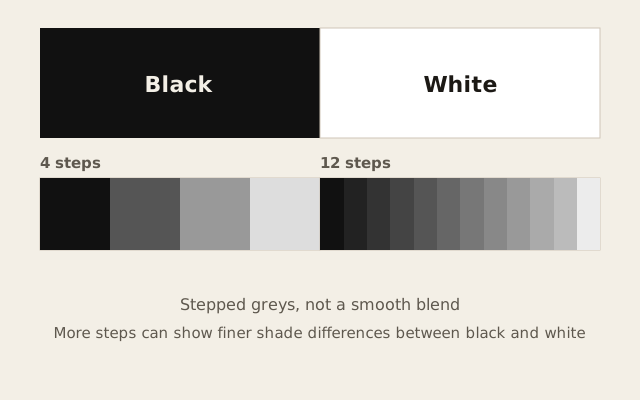
Contrast ratio compares the brightest white a display can make to the darkest black. Higher contrast usually means a punchier picture: scores that pop, graphics that do not look milky.
The diagram above starts with that black-to-white gap. Below it, two grey scales use discrete steps instead of a smooth blend. The left scale has fewer steps; the right has more. A wall that can hold those steps apart looks less milky in mid-tones, not only at pure black and pure white.
Direct-view LED can turn a pixel fully off, so blacks can be very deep in a dark room. In a bright gym, ambient light bouncing off the face of the wall is what kills contrast. That is why LED masks, cabinet finish, and where the wall sits relative to windows matter.
Datasheet contrast numbers are measured in labs. Use them as a relative guide between products, not as a promise of what the bleachers will see at 2 p.m. with the house lights on.